Connecting the Human & Machine with an AI Workflow
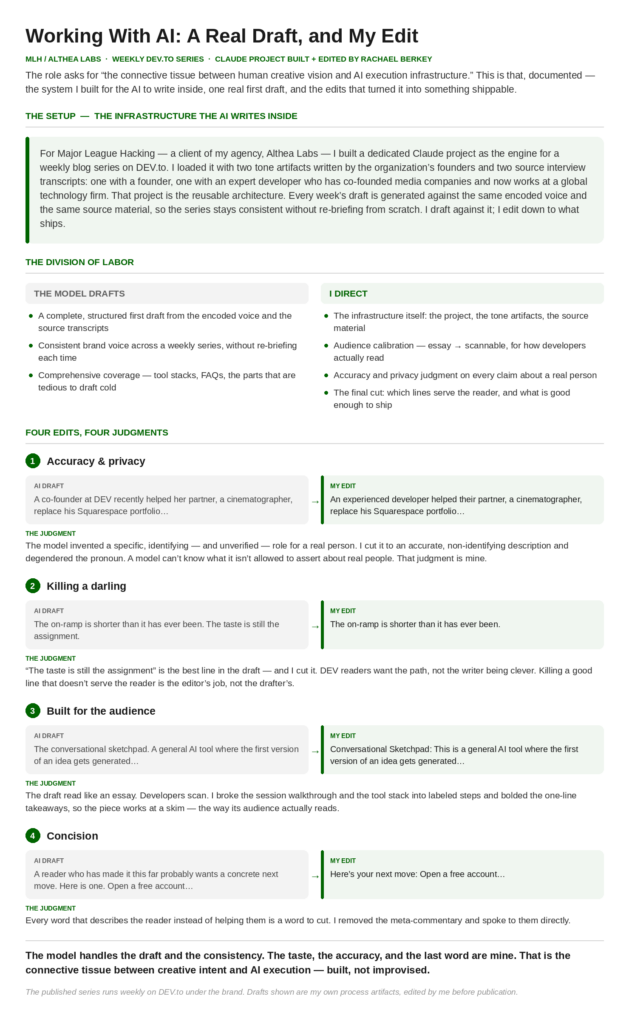
This case study is the workflow, documented: the reusable infrastructure I built for the model to write inside, one real first draft, and the edits that made it shippable.
The Challenge: Every content team is now facing the same question: how do you integrate generative AI into a real editorial workflow without the output collapsing into generic AI prose? Adoption is easy. Anyone can paste a prompt. What’s hard is building an AI-assisted content system that holds: brand voice encoded so a model can actually draft inside it, human-in-the-loop editorial oversight at the points where judgment can’t be delegated, and quality control that scales with the publishing cadence instead of fighting it. Most teams are improvising this. I’ve been operationalizing it – for a real client, on a weekly schedule, for an audience of developers who can smell unedited AI output instantly.
Owned vs. Directed: I directed the model to a complete, structured first draft each week – generated against the encoded voice and source material, covering the parts that are tedious to draft cold: tool stacks, FAQs, the connective explanations. The consistency is the system’s job, not a weekly act of will.
I owned everything the model can’t. The infrastructure itself: a dedicated Claude project for Major League Hacking, a client of Althea, loaded with two tone artifacts written by the organization’s founders and two source interview transcripts. It has become a reusable architecture that means the series never gets re-briefed from scratch.
With every project, I calibrate alongside it. First, the model writes essays. Then developers scan for technical accuracy when necessary. Finally, I provide a layer of editorial restructuring to address any instinctual persona notes, idiosyncrasies to a topic that the model could not know. I feed a final edit back to the project each time to teach the model some of these personal edit choices so that the following essay can be completed more quickly and more accurately the first time.
Approach to Voice: A model can only hold a voice that’s been made checkable, so the same discipline from my brand-book work applies here: voice encoded as artifacts and source material, not vibes in a prompt. But drafting is the smaller half of voice work – the senior half is editorial judgment, and the four edits in this case study are four different kinds. Accuracy: the model invented a specific, identifying, unverified role for a real person; I cut it to an accurate, non-identifying description and degendered the pronoun, because a model can’t know what it isn’t allowed to assert about real people. Taste: “the taste is still the assignment” was the best line in the draft, and I killed it – DEV readers want the path, not the writer being clever. Audience: an essay broken into labeled steps and bolded takeaways so the piece works at a skim. Concision: every word describing the reader instead of helping them, cut. The voice survives the model for the same reason it survives a cross-functional team – because it’s a decision you can check every line against.
Outcome: The series runs weekly on DEV.to under the brand, on the same architecture, without re-briefing – consistency as a property of the system rather than the schedule. The division of labor held: the model handles the draft and the consistency; the taste, the accuracy, and the last word are mine. That’s the connective tissue between creative intent and AI execution.