I started in communities – live-tweeting Sunday-night television, watching a fanbase show up not because a brand asked them to, but because the words made them feel like they belonged. That’s where I learned what voice actually does: it’s the thing that makes a brand sticky.
Whether it’s a scripted series, marketing copy for a new product, or a long-form explanation of how and why a new technology works, the right words make people stay. And come back – a second time, a third, a twentieth.
Brands lose this constantly. They get mired in technicality, in a format that has “always worked,” in the one word a stakeholder loves or hates. But the person on the other end doesn’t care about format, or jargon, or any single word. (The thing has to be true, and it has to work. That part isn’t negotiable.) What they care about is how the story makes them feel, and whether it moves them.
Fifteen years later, the subjects have gotten harder (encryption, AI research, city policy) but the job hasn’t changed. Readers and consumers still react to clarity, warmth, and precision as forms of care. What’s changed is scope: I no longer just write the voice, I define the systems that let a team carry it across every channel without losing the thread, and I build it now alongside AI, using the technology as an assistant that I provide with guidance and tools while I continue to own creative guardrails, editorial oversight, and final approval.
The case studies that follow are organized around that idea: the craft first, then the systems that scale it.
Redefining Voice Post-Breach with LastPass
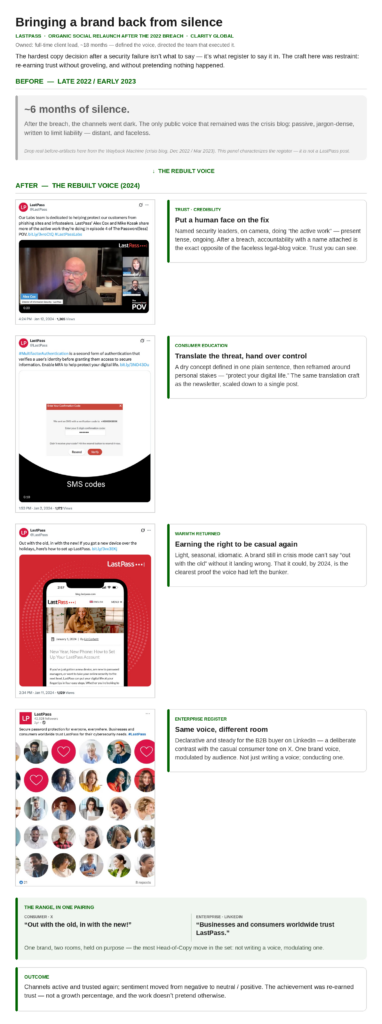
Challenge: Six months of channel dormancy + defensive, legalistic crisis voice after a major breach. I pitched and won the chance to rebuild a customer-facing voice that could talk to people again and change online sentiment for the brand. Over the course of 18 months, we built a new social persona and voice that spoke directly to people rather than speaking to the past.
Owned vs. Directed: I led the agency team of 4 junior writers and creatives while working closely with the agency’s creative studio. From the beginning, I built the social strategy from the ground up – persona development, voice & tone do’s and don’ts, and reporting to ensure stakeholders remained confident in our work. Internally at Clarity, I mentored younger writers, ideated on content pillars and creative execution, and managed daily writing and posting.
Approach to Voice: I knew from past experience that the craft here was restraint – knowing when not to be clever, knowing when to be brutally transparent as far as the legal department allowed, and knowing when to engage passively and actively as the brand. A recently compromised password manager cannot be witty.
Outcome: Sentiment shifted from negative → neutral/positive within 90 days of the channels going live again. While some audience members remained (and continue to remain) negative, the broad social audience returned to business as usual.
Craft & Creativity for BBC America’s Killing Eve
Challenge: A returning prestige show going darker in Season 3, a fandom that polices tone harder than any brand team, and three corporate handles that all need to talk about the same property without sounding like one account copy-pasted. The craft problem: be menacing and playful without ever tipping into scary or unkind. The unspoken complications:
- COVID-19, which shortened our pre-promotion window by a month as networks scrambled to entertain a society in lock-down;
- Political tensions as social media exploded after the murder of George Floyd.
Owned vs. Directed: At EA1, I threaded the needle: I directed the corporate account management and owned the Killing Eve voice outright. I developed the persona and voice of the accounts, working closely with our agency team and the client’s video production and press departments. I handled all live-tweeting, UGC, and community moments live.
From pre-season promotion that I turned into appointment-social media with timed and teasing content drops, through post-season response to a fandom reacting to the political climate through their engagement with a show that centered queerness and race, Killing Eve Season 3 presented unique opportunities to play, to comfort, and flex my own writing muscles when I had to translate internet casualness into corporate reporting to stakeholders at AMC, the show’s production team, and the BBC.
Approach to Voice: Killing Eve was incredibly fun. The directive initially (with Season 2) was witty, culturally tuned, and aggressive – almost brutal – but always without crossing the line into meanness or cruelty. It was the tonal opposite of previous clients at the NYC Mayor’s Office and earlier technology startups. As Season 3 progressed, the pandemic took hold, and political movements erupted, it also became a proving ground for being able to hold a fandom in the palm of my hand with a single account while writing for corporate and political stakeholders at the same time.
Outcome:
- #1 Cable TV Drama in Interest and Engagement, ranking #2 overall in Interest score amidst cable TV programs behind only ESPN’s The Last Dance and #4 in Social Engagement (ListenFirst Interest & Social Engagement Scores)
- #2 Cable TV Drama in Conversation behind only Shadowhunters, ranking #3 overall amidst cable TV programs (ListenFirst Conversation Score)
- Engagement up +2.4x on Killing Eve handles vs. S2
- 1.62M Twitter mentions driving 884M impressions
- 89% Positive-Neutral Sentiment
Defining & Refining Voice for AMC+ Social Launch
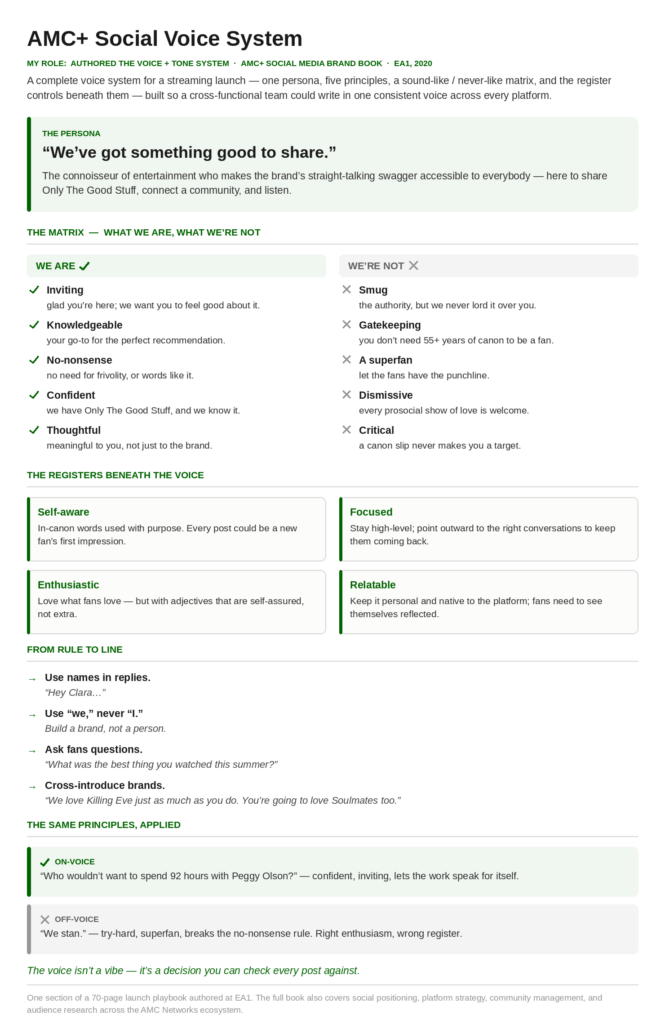
Challenge: AMC+ is a streaming service that was launching with no voice history, a cross-functional team of writers who’d never met the brand, and a portfolio of properties (each with its own rabid fandom) that the parent voice had to sit above without flattening. I was tasked with creating a parent persona that could draw in new fans without alienating old ones while also playing intelligently with existing properties without stifling any of the property teams’ creativity.
Owned vs. Directed: I owned creating the voice and persona for this client expansion within a scope where we were already the agency of record. From ideation through pitch, I developed how AMC+ would tell their story on social.
Approach to Voice: My approach to voice starts from a simple conviction: a voice isn’t a vibe. It’s a set of decisions a writer can check a sentence against. So I define voices by their edges, because “what we’re not” is what someone actually consults at 11pm on a launch night. I build personas instead of adjective lists, because a character can be improvised in and a word cloud can’t. I write the rules all the way down to the line with every principle demonstrated in a real sentence, never left as an abstraction. And I treat register as the senior skill: one voice, modulated by room, so the brand sounds like itself whether it’s reassuring a consumer or teasing a fandom. The test of the work isn’t whether I can write the voice. It’s whether the voice still sounds right after it leaves my hands.
Outcome: The voice system shipped as the social section of a 70-page launch playbook and governed a cross-functional team’s output through launch.
Translating the Technical for Skeleton Key
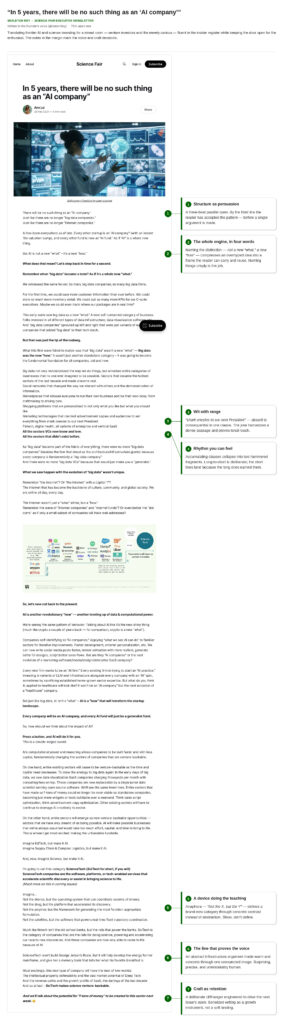
Challenge: Translate frontier AI / science investing into a newsletter that educates and engages a smart-but-mixed room (VCs and curious non-specialists). The goal was to get them to read to the end and come back to reference the work later.
Owned vs. Directed: For this six month project, I was an executive ghostwriter for Skeleton Key’s founder, Ann Lai, owning the translation of her voice notes, conversations, and fundraising deck into engaging and educational newsletter content that anyone could read but that spoke to our target audience. To do this, I worked closely with Ann to define and evolve her brand voice, and then executed the newsletter based on that work.
Approach to Voice: I had to calibrate the work to fulfill a dual need: speak to the stakeholder in their own terms, but keep everything relatable enough to ensure the science or tech enthusiasts stay in the room.
Outcome: 76% open rate for six months
Connecting the Human & Machine with an AI Workflow
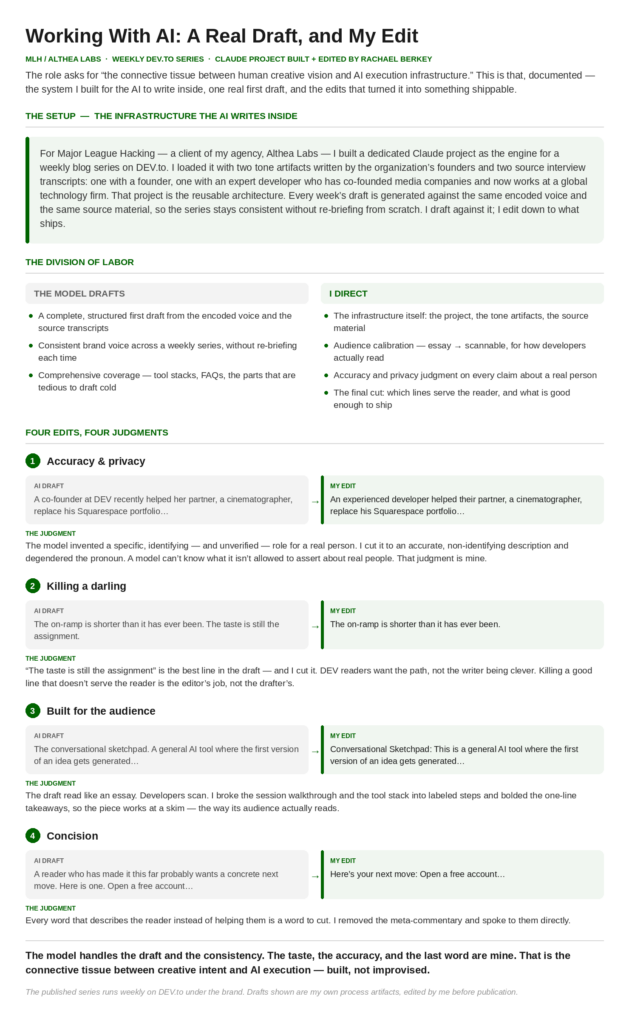
This case study is the workflow, documented: the reusable infrastructure I built for the model to write inside, one real first draft, and the edits that made it shippable.
The Challenge: Every content team is now facing the same question: how do you integrate generative AI into a real editorial workflow without the output collapsing into generic AI prose? Adoption is easy. Anyone can paste a prompt. What’s hard is building an AI-assisted content system that holds: brand voice encoded so a model can actually draft inside it, human-in-the-loop editorial oversight at the points where judgment can’t be delegated, and quality control that scales with the publishing cadence instead of fighting it. Most teams are improvising this. I’ve been operationalizing it – for a real client, on a weekly schedule, for an audience of developers who can smell unedited AI output instantly.
Owned vs. Directed: I directed the model to a complete, structured first draft each week – generated against the encoded voice and source material, covering the parts that are tedious to draft cold: tool stacks, FAQs, the connective explanations. The consistency is the system’s job, not a weekly act of will.
I owned everything the model can’t. The infrastructure itself: a dedicated Claude project for Major League Hacking, a client of Althea, loaded with two tone artifacts written by the organization’s founders and two source interview transcripts. It has become a reusable architecture that means the series never gets re-briefed from scratch.
With every project, I calibrate alongside it. First, the model writes essays. Then developers scan for technical accuracy when necessary. Finally, I provide a layer of editorial restructuring to address any instinctual persona notes, idiosyncrasies to a topic that the model could not know. I feed a final edit back to the project each time to teach the model some of these personal edit choices so that the following essay can be completed more quickly and more accurately the first time.
Approach to Voice: A model can only hold a voice that’s been made checkable, so the same discipline from my brand-book work applies here: voice encoded as artifacts and source material, not vibes in a prompt. But drafting is the smaller half of voice work – the senior half is editorial judgment, and the four edits in this case study are four different kinds. Accuracy: the model invented a specific, identifying, unverified role for a real person; I cut it to an accurate, non-identifying description and degendered the pronoun, because a model can’t know what it isn’t allowed to assert about real people. Taste: “the taste is still the assignment” was the best line in the draft, and I killed it – DEV readers want the path, not the writer being clever. Audience: an essay broken into labeled steps and bolded takeaways so the piece works at a skim. Concision: every word describing the reader instead of helping them, cut. The voice survives the model for the same reason it survives a cross-functional team – because it’s a decision you can check every line against.
Outcome: The series runs weekly on DEV.to under the brand, on the same architecture, without re-briefing – consistency as a property of the system rather than the schedule. The division of labor held: the model handles the draft and the consistency; the taste, the accuracy, and the last word are mine. That’s the connective tissue between creative intent and AI execution.